Christopher Chapin:
Teaching Portfolio
US History & Government Contents (Click on link to jump to specific item or scroll down through page)
- Early American History through Memes/Social Media
- Student Work: Peter Zenger Case Prompt
- How a Bill Becomes a Law Lesson
- Vocabulary & Supreme Court Cases Worksheets and Quizzes
- Debate: Pros and Cons of Unions
- The Oregon Trail
- 2013 Regents Review Sessions
- Andrew Jackson as President
- Era of Good Feelings Lesson
- Boston Massacre Newspaper Project
- Checks and Balances Graphic Organizer
- US Constitutional Convention Lesson Plan
- US Constitution Webquest
- US Landmark Supreme Court Cases Graphic Organizer
Early American History Through Memes/Social Media
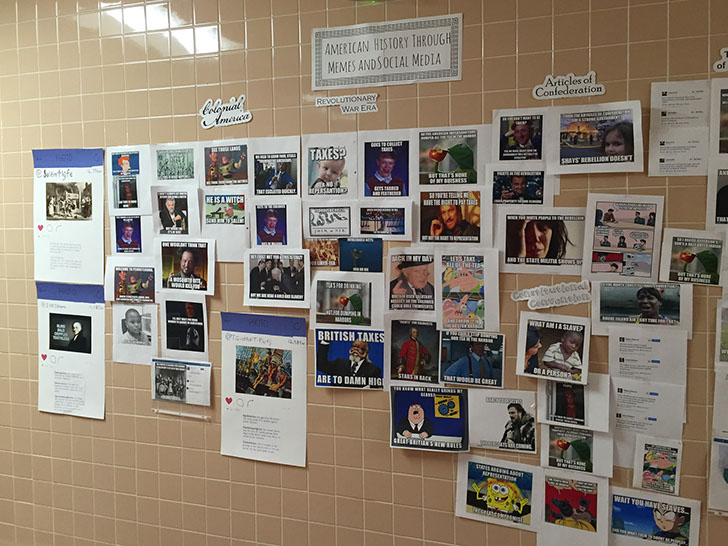
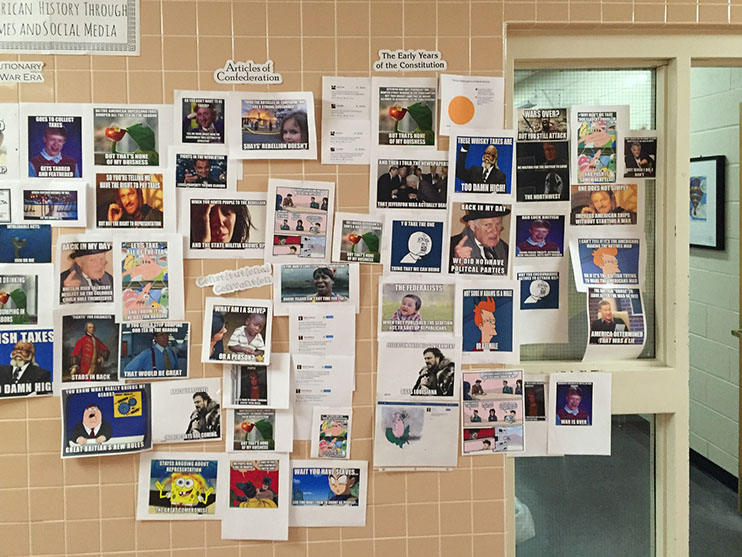
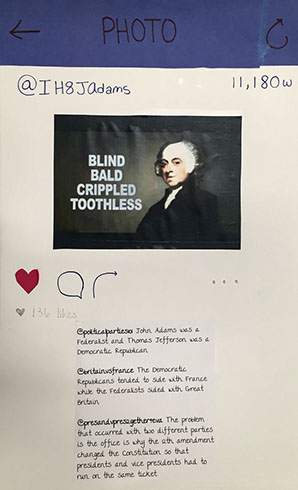
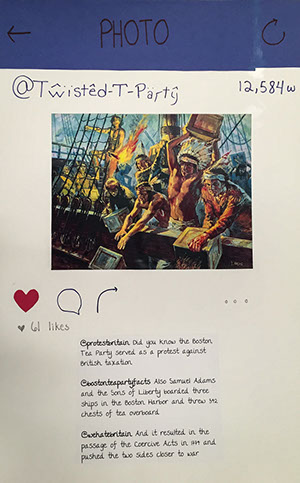
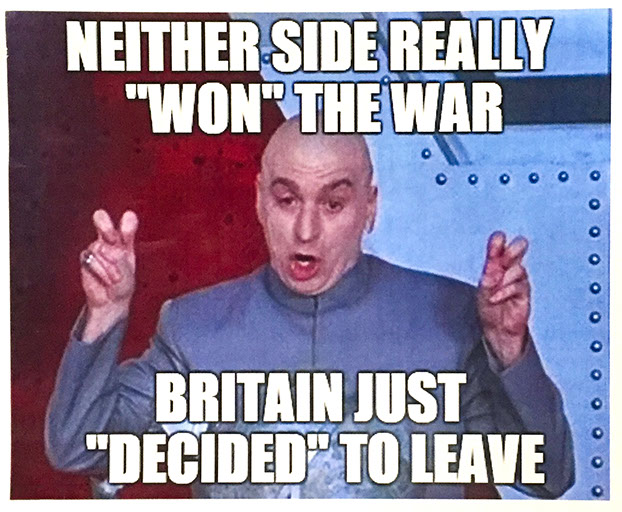
While long-term substitute teaching at Potsdam Central School, students had to reinterpret American history through a modern lens by making use of technology and trends they are familiar with: memes and social media. Students had the option to retell American history through memes or by making mock up social media profiles for various figures. For instance, some students created mock Twitter accounts to imagine how the campaigns from the Election of 1800 would look today. Other students created mock Instagram pictures to highlight key events of the American Revolution. Students worked in groups of two to three on the project. One final component of the project was for students to write a brief reflective piece of about one page in length. In it, students needed to discuss what they learned from the project, what aspect of the project they felt they were most successful in completing, and what aspects they found to be most challenging. In addition, students needed to mention how they overcame or tried to overcome any of those challenges. Click here to download the project guidelines
Example 1
Example 2
Example 3
Example 4
Example 5
5 - 5
<
>
Student Artwork: Peter Zenger Case Prompt
While working at PCS as a long-term substitute teacher, a student at the beginning of the year volunteered to draw prompts related to upcoming lessons on the classroom's back whiteboard. In this example, the student drew a promo for the lesson on the Peter Zenger case.
How a Bill Becomes a Law
This is a one day activity in which students learn how a bill becomes a law. The lesson used a variety of instructional methods, including the use of an audiovisual for an introduction, brief lecture of the legislative process, and a simulation activity.
In the simulation, students were assigned various roles. One student is assigned the role of President. Of the remaining students, two-thirds were assigned Representatives, and the remainder were assigned Senate. Within these two groups, about half were given a second role as committee member. Once roles were assigned, all of the students were asked to "write a bill." For example, one student wrote "legalize pot." Another student wrote "all schools must sell soda in vending machines." The students then put their bills in the hat. Then I pulled a bill at random out of the hat. Then I asked if a Representative or Senator (other than the bill writer) was willing to endorse the bill, thus beginning the legislative process. For most of the activity, the students determined if a bill would pass or be killed. However, during a couple of scenarios, I had students act out certain situations. For example, I had one chamber change one word, therefore causing one student from each chamber's committee to have to discuss the bill.
In the fall of 2015, I made use of this lesson while long term-substitute teaching at PCS. The classroom was set up to visually represent the two chambers of Congress. The students were actively engaged the whole class and enjoyed the lesson. Many commented afterwards how the lesson helped them to understand how Congress works. Other teachers throughout the day mentioned to me how the students were still talking about the lesson following class.
Vocabulary & Supreme Court Cases Worksheets and Quizzes
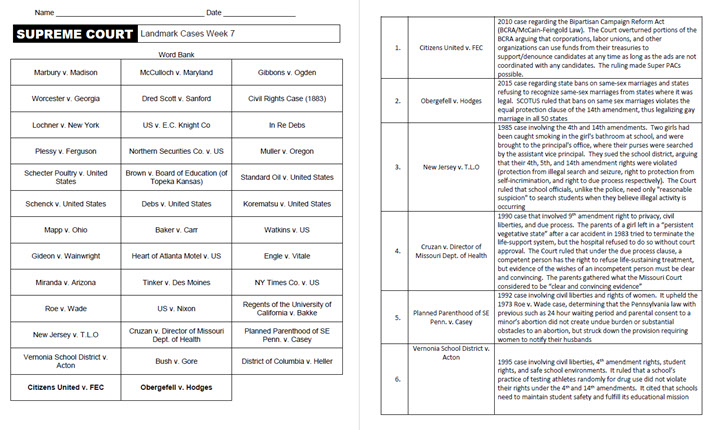
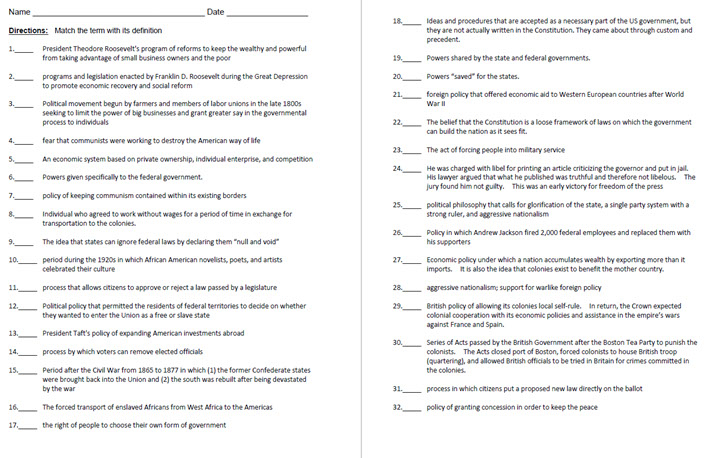
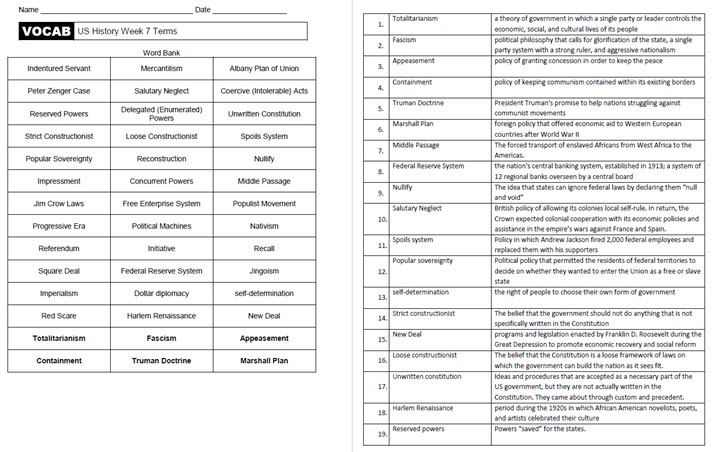
While tutoring a student for PCS for the majority of the school year (October through June), I developed a series of weekly worksheets and quizzes to help the student learn key terms and Supreme Court cases to help them prepare for the Regents exam. Each Monday, starting in April, the student received two worksheets, one with vocabulary terms, and one with Supreme Court terms. The student needed to match the term with the definition and the court case with its description. Once completed, the worksheets were designed so that they could be folded in half and used as flashcards. On Fridays, the student would take two "quizzes" on the vocabulary and court cases. The worksheets and quizzes were cumulative. For example, for the second week, all of the first week terms and cases were on the second week's terms and cases worksheets and quizzes.
The vocabulary term worksheets I developed for tutoring came from the quizzes I made while long-term substitute teaching at PCS. While teaching at PCS, each week, I would introduce two to three new terms on a Monday and on Friday, students would take cumulative vocabulary quizzes. The idea behind this is to help students remember key concepts from the course through repetition. As more terms were added to the list, I would give a crossword worksheet in the middle of the week. Students who completed with all of the correct answers, and turned it in on Fridays before the quiz, recieved a 5 point bonus on their quiz.
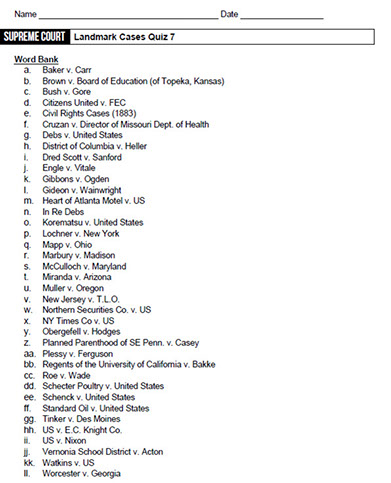
Supreme Court Case Quiz (Click to Download PDF)
Supreme Court Case Matching Worksheet (Click to Download PDF)
Vocabulary Terms Quiz (Click to Download PDF)
Vocabulary Terms Matching Worksheet (Click to Download PDF)
1 - 4
<
>
Debate: Pros and Cons of Unions
As part of the unit on industrialization and the rise of labor unions, students were asked to develop a list of the pros and cons of labor unions. To do this, students needed to reach out to adult friends, other teachers, family members, etc. to help them develop their lists of reasons for and against labor unions. This was assigned for homework. The following class day, students were broken up into groups of four, and within their groups, they were further subdivided into pairs. One pair had to argue for labor unions while the other pair had to argue against them. Each group debated the topic amongst themselves. As they debated, I monitored each group's discussion and would occasionally need to moderate group discussions by prompting discussion through the use of questioning. As a closure activity for the lesson, I had the class as a whole share their thoughts about what they learned. For a couple of classes that were not as willing to speak up, I had students write down on a half sheet of paper which argument for unions and which one against them they thought were the strongest arguments and they needed to explain why.
The Oregon Trail
As part of the unit on Westward Expansion, students examined the Oregon Trail by playing the original Oregon Trail game, available on the US government's web archive (https://archive.org/details/msdos_Oregon_Trail_The_1990). The lesson made use of PCS's chromebooks. Each student had a chromebook and was able to play the game. As the students played the game, they needed to share what was happening to them. For example, students shared each time a member of their team died and how they died. Students also shared when they were hit by a blizzard or a tornado. As students shared what was happening to them, I created a list on the classroom's smartboard. To end class, the students discussed the difficulty the settlers faced as they traveled on the Oregon Trail. For homework, students had to write a brief, one paragraph reflective response on what the purpose of the Oregon Trail was, the legacy of the trail, and why travelers faced many difficulties on their trek.
2013 Regents Review Session
In June 2012, I held three regents review session for Global Studies. This year in June 2013, in addition to holding Global review sessions, I held three US History and Government review session. These review sessions went smoothly because I have had the opportunity to work with these students on multiple occasions for the last two years. For the US History Review Sessions, I covered US Constitutional Foundations, Landmark Supreme Court Cases, Foreign Policies, Key Literary Works, and US Geography and Demographics. I used a variety of instructional techniques to review the material. I used PowerPoint presentations to provide a brief overview of key material. I also used a matching game. For the matching game, students had to work in teams. Each team was given a stack of cards. Within those stack of cards, three of them identified a branch of government. For example, one card said "Legislative Branch," while another stated "Executive Branch." The remainder of the cards included key elements that described each of the three branches of government. The students then had to sort through the cards and match all of the Legislative Branch cards with the Legislative Branch heading, and they had to repeat the process for the Executive Branch and Judicial Branch. In addition to the matching card game, I used Jeopardy PowerPoint games and a "Find Someone Who" Activity in which each student was given a worksheet, and each student was asked to answer one specific question from the sheet. Once they answered their question, they had to go around the room to find the other answers by talking to their peers
Andrew Jackson as President
This was a one day lesson on the presidency of Andrew Jackson. In this lesson, I incorporated pictures from my personal travels. The summer before I taught this lesson, I visited Andrew Jackson's plantation outside of Nashville, Tennessee called the Hermitage. The pictures I took was and used was an effective tool for encouraging discussion and sparking student interest. In addition, I was able to incorporate the information I learned from that experience into the lesson.
Era of Good Feelings Lesson
This was a one day lesson on the Era of Good Feelings. Throughout the presentation, I included pictures from my travel of southern plantations, and the slave quarters, to give a visual since the textbook gave only a drawing of the layout of a typical plantation. The students were interested in the pictures, and they helped start a class discussion on the topic of differences in the northern and southern economies in the early 19th century.
Boston Massacre Newspaper Project
For this project, students went to the computer lab for two classes to research the Boston Massacre. Once students were done researching, they were to write a headline news article about the issue. However, they had to put a spin on the article. For example, they could write the article from the perspective of a British soldier, or they could write from the point of view of the colonists. In addition, students had to create the front page of a newspaper to feature the article. The front page had to include extras. The extras were up to the students. For example, some students added a weather report sidebar.
Checks and Balances Graphic Organizer
This graphic organizer is for a homework assignment on Checks and Balances.
US Constitutional Convention Lesson Plan
This is a one day lesson on the United States Constitutional Convention. The lesson uses primarily lecture, and covers the various debates, such as the Virginia and New Jersey Plans. In addition, the lesson examines the events that led up to the Constitutional Convention
US Constitution Webquest
I designed this webquest for both 7th Grade and 11th Grade US History classes. The purpose of the webquest is for students to learn about the creation of the US Constitution. In addition to examining the history of the United States government, the webquest focuses on developing student's critical thinking and communication skills, as students are required to work together and develop their own constitution.
US Landmark Supreme Court Cases Graphic Organizer
I created this table of Key Landmark Supreme Court Cases students must know, as cited in the NYS Core Curriculum. I posted it on my class website in June 2013 for students to download to help them prepare for the regents exam. It contains a brief background on how the case arose, the key question the case settled, the court decision, and the key concepts the case dealt with.
Site designed and maintained by Christopher Chapin. Last updated June 24, 2017. All links and content were working at the time of last update. Please report any broken links by using the contact form on the Contact Page or by e-mailing me directly at: chapincm190@potsdam.edu